


European Center for Advanced Research in Economics and Statistics
News
EDT-Day – March 28th

The EDT STAT-ACTU is organizing its EDT-day on Friday March 28, 2025. It will take place in room “Salle des professeurs” on the 9th floor of the NO building (La Plaine, ULB). The program can be found below: Registration, free but compulsory, can be made on this page: Session 1 9.30am – 10am: Welcome (coffee and …
Continue reading "EDT-Day – March 28th"
Estelle Cantillon Organizes Belgian Environmental Economics Day (BEED 2025)
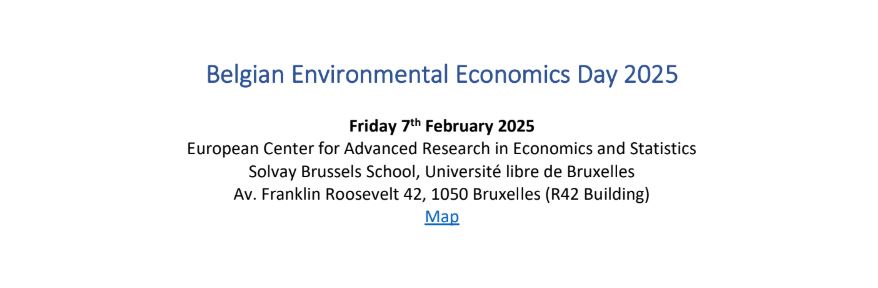
ECARES member Estelle Cantillon organized the Belgian Environmental Economics Day (BEED 2025), a key event for environmental economists in Belgium. The day brought together experts , and researchers to discuss pressing environmental issues through an economic lens. The event featured a series of presentations and discussions on various topics within environmental economics, providing a platform …
Continue reading "Estelle Cantillon Organizes Belgian Environmental Economics Day (BEED 2025)"
ECARES Welcomes Nobel Prize Laureate Jean Tirole for a Seminar
12 February 2025On February 6th, ECARES (Economics and Computing Research School) had the honor of welcoming Jean Tirole, the Nobel Prize-winning economist of 2014, for a prestigious seminar. Tirole, renowned for his groundbreaking work in industrial organization and market regulation, shared his insights on contemporary economic challenges. His presentation focused on his recent paper titled Engineering Commonality, …
Continue reading "ECARES Welcomes Nobel Prize Laureate Jean Tirole for a Seminar"
Publications

Paris Report 3: Global Action Without Global Governance: Building coalitions for climate transition and nature restoration
Guntram B. Wolff, Jean Pisani-Ferry, Beatrice Weder di Mauro, Jeromin Zettelmeyer, Heather Grabbe, Simone Tagliapietra, Luca Fornaro Jean Pisani-Ferry, Lucrezia Reichlin, Emmanuel Guérin, Laurence Tubiana, Kimberly Clausing, Joseph Aldy , Dustin Tingley, Catherine Wolfram, Ottmar Edenhofer, Matthias Kalkuhl, Max Franks, Vera Songwe, Partha Sen, Erik Berglöf, Stuart Macintosh, Hélène Rey, Abhijit Sen Gupta, Murtaza Syed , Chunping Xie

Working paper : The Impact of Firm-level Covid Rescue Policies: Evidence for Wallonia (2025-09)
Glenn Magerman & Dieter Van Esbroeck
Working paper : Managing Policymakers’ Biases in Dealing with Uncertain Hospital Capacity Needs (2025-08)
Omar Chisari & Antonio Estache
Trust and Development in Conflict-Affected Countries (Special Feature) (2025-07)
Andrew Foster, Philip Verwimp, Patricia Justino and Tilman Brück
Working paper : Fertility in Sub-Saharan Africa: the Role of Inheritance (2025-06)
Sébastien Fontenay & Paula Eugenia Gobbi & Marc Goñi
Calendar
- 21 July 2025
-
-
Jul
21public holiday
-
- 15 August 2025
-
-
Aug
15Public Holiday
-
- 30 September 2025
-
-
Sep
30Eva Raiber, Aix-Marseille Université
Tuesday, 14:00 - 15:30
Location:
-
- 7 October 2025
-
-
Oct
07Ahmad Lashkaripour, Indiana University
Tuesday, 14:00 - 15:30
Location:
-
- 21 October 2025
-
-
Oct
21Michele Fioretti, Università Bocconi
Tuesday, 14:00 - 15:30
Location:
-
- 1 November 2025
-
-
Nov
01ULB Closed
-
- 2 November 2025
-
-
Nov
02ULB Closed
-
- 4 November 2025
-
-
Nov
04Saptarshi Mukherjee,Indian Institute of Technology Delhi
Tuesday, 14:00 - 15:30
Location:
-
- 11 November 2025
-
-
Nov
11Public holiday
-
- 20 November 2025
-
-
Nov
20Public Holiday - St V
-
Visit us
ECARES - Solvay Brussels School of Economics and Management
Ave. F.D Roosevelt 42, 5th and 6th floors
1050 - Brussels - Belgium